
December 20, 2025,16 min. to read
Marat Kazey: a young hero of the Great Patriotic War
Marat Ivanovich Kazey was born on October 10, 1929, in the Belarusian village of Stankovo, Dzerzhinsky District, Minsk Region. His fate became a symbol of courage and self-sacrifice of an entire generation of Soviet children who rose to defend their Motherland during the most terrible years of the war. The name of this fourteen-year-old partisan scout is forever inscribed in history as an example of selfless bravery and fidelity to his convictions.Childhood in a family of communists
Marat was born into a family of committed communist activists. His father, Ivan Georgievich Kazey, served for ten years in the Baltic Fleet on the legendary battleship “Marat,” after which he named his son. After his service, he returned to his native village, where he worked as a tractor driver at a machine and tractor station and headed courses for training mechanized workers. For his active participation in building a new life, Ivan Georgievich was awarded leather breeches and a tunic, which in those years was considered a great honor. Marat’s mother, Anna Alexandrovna Kazey, was also an active supporter of Soviet power. She traveled through villages, agitated for collective farms, created youth organizations, and spoke at border outposts. The border with Poland ran very close to their home, and the woman considered it her duty to help strengthen the Soviet system.Family tragedy
Despite their devotion to communist ideals, in 1935 Marat’s parents were arrested on denunciation. The children were taken in by relatives, and the family effectively ceased to exist. The father died in a labor camp in the Far East, where he had been exiled on charges of sabotage. The mother was released in 1939, but she learned of the deaths of three of her children. By that time, Anna Alexandrovna had only two left — Marat and his older sister Ariadna, born in 1925. The family tragedy did not break Anna Alexandrovna or embitter her against the authorities. She continued to work on the collective farm, raise her children, and believe in a bright future. Marat managed to finish four grades of a rural school, helped his mother around the household, and was an ordinary village boy with an unusual name.The beginning of the war and the loss of his mother
When the Great Patriotic War began in the summer of 1941, the life of the Kazey family changed completely. German troops quickly occupied Belarus, and an enemy garrison was stationed in the village of Stankovo. The school where Marat studied was turned into German barracks. Schooling ended — the boy never went on to the fifth grade. Anna Alexandrovna could not come to terms with the occupation. Despite being the wife of a repressed man, she began cooperating with the partisan underground. She hid wounded partisans in her home, treated and fed them, and passed on important information. The children helped their mother, fully understanding the danger of this activity. However, there was a traitor who informed the Germans about Anna Alexandrovna’s activities. In 1942 she was arrested, taken to Minsk, and on November 7 publicly hanged on Freedom Square. The children were left complete orphans. They had no one and nothing left to lose — ahead lay only revenge for their mother and the struggle against the enemy.In the partisan detachment
In November 1942, thirteen-year-old Marat and his seventeen-year-old sister Ariadna went into the Stankovo forest, where the partisan detachment named after the 25th Anniversary of the October Revolution was based. At first, the command did not want to take such young fighters, but the children were full of determination. Moreover, they knew the terrain well and had no home to return to. The partisans took care of Marat, understanding that he was still a child. Ariadna washed and repaired the fighters’ clothes, stood duty in the kitchen, but gradually she began, on equal footing with adults, to stand guard, go on reconnaissance, and take part in combat operations. Marat became an assistant to the scouts and then began to carry out responsible assignments himself.The combat path of the young partisan
First battle and first award
Marat Kazey entered his first real battle only in January 1943. The commanders tried not to expose the boy to excessive danger, but in that operation his participation was necessary. In his very first battle, Marat was lightly wounded in the arm, but he did not leave his position and continued to fight. By his example, he inspired his comrades to counterattack, which ended in success. For this battle, the fourteen-year-old partisan was nominated for the medal “For Courage” — a true combat soldier’s award, given only for serious merit and real bravery. This was recognition that Marat had become a full-fledged fighter who could be relied upon in the most dangerous situations.Scout of the partisan detachment
After his wound, Marat became a scout. The fearless and quick-witted boy proved ideally suited for this dangerous work. He could quietly penetrate a German garrison, remember troop dispositions, and obtain important information. The appearance of an ordinary village teenager aroused no suspicion among the occupiers, allowing Marat to carry out tasks inaccessible to adult partisans. After Marat’s reconnaissance, the partisans carried out a daring raid and defeated the German garrison in the town of Dzerzhinsk. The young fighter also took part in sabotage operations — blowing up railway tracks, destroying communication lines, and attacking enemy convoys. Despite his young age, he demonstrated the composure and restraint of an experienced soldier.Saving the detachment near the village of Rumok
One of Marat’s most heroic feats was accomplished in March 1943. The partisan detachment named after Furmanov was surrounded near the village of Rumok. German punitive forces closed a tight ring, and all attempts to break out were unsuccessful. Delay threatened the destruction of the entire detachment — more than a hundred people could have been killed. In this critical situation, Marat Kazey volunteered to break through the enemy lines and bring reinforcements. It seemed an impossible task, but the boy managed to use his knowledge of the terrain, the darkness of night, and his agility. He miraculously broke through the dense ranks of the attacking Germans and reached a neighboring partisan detachment. Thanks to the courage and determination of the fourteen-year-old hero, reinforcements arrived in time. The enemy was driven back, dozens of fighters survived, and the detachment remained a full-fledged combat unit. For this feat, Marat earned the recognition and respect of all the partisans.Tragedy of his sister and refusal of evacuation
In the winter of 1943, during another breakout from encirclement, tragedy struck. Ariadna Kazey frostbit both of her feet, and gangrene set in. The partisan doctor Ivan Maksimovich Dyachenko was forced to amputate both of the girl’s legs with a saw heated over a fire, without anesthesia, under field conditions. Her comrades simply held her hands during this terrible operation. After the amputation, Ariadna’s condition remained critical, and she was evacuated by plane to the rear. The seventeen-year-old girl faced a long rehabilitation and a completely different life without legs. Marat was also offered to fly away with his sister — he was a minor, had the right to leave the front line, finish school, and live a normal life. But the courageous boy categorically refused. He could not leave his comrades, could not stop fighting while the enemy trampled his native land. Marat remained in the detachment and continued to carry out combat missions with even greater determination.Obtaining important documents
In the winter of 1943, during a battle on the Slutsk highway, Marat accomplished another important feat. As a result of a daring operation, he obtained critically important enemy documents — maps and plans of the German command showing troop dispositions, defensive systems, and movement routes. These documents were delivered to the advancing units of the Soviet Army and greatly aided the liberation of Belarus. The information obtained by the young scout helped save the lives of many Soviet soldiers and accelerated the advance of our troops. For the heroism shown in the fight against the occupiers, for numerous combat operations and reconnaissance activities, by the end of 1943 the fourteen-year-old Marat Kazey was awarded several high honors: the medals “For Courage” and “For Combat Merit”, as well as the Order of the Patriotic War, 1st Class.The last battle and heroic death
On May 11, 1944, Marat Kazey and the commander of the partisan reconnaissance Mikhail Stepanovich Larin were returning from another mission. They had been behind German lines, gathered important information, and were heading back to their detachment. Near the village of Khoromitskie in the Uzda District of the Minsk Region, they were discovered by German punitive forces and collaborators. A fight broke out. The commander was killed almost immediately, receiving a fatal wound. Marat was left alone against superior enemy forces. The boy fought back until the last cartridge, trying to break through to the forest edge where he could take cover. However, the enemies surrounded him from all sides. When the ammunition ran out, Marat was already seriously wounded. The Germans demanded that he surrender, wanting to take the young partisan alive. But the fourteen-year-old hero knew what awaited him in captivity — torture, abuse, and a painful death. He could not allow the enemy to claim this victory. Waiting until the Germans came very close, Marat Kazey blew himself up along with the surrounding enemies with his last grenade. The explosion cut short the brief but fantastically heroic life of a boy who remained faithful to his convictions and comrades until his last breath.Awards and memory of the hero
Posthumous conferment of the title Hero of the Soviet Union
Marat Kazey’s body was buried by his comrades at the place of his death. In 1946, his remains were reburied with military honors in his native village of Stankovo, where an obelisk was erected. And on May 8, 1965, to mark the twentieth anniversary of the Victory over the Nazi invaders, Marat Kazey was posthumously awarded the title Hero of the Soviet Union. The Hero’s Star and the Order of Lenin — the highest awards of the USSR — were solemnly presented to his sister Ariadna Ivanovna. By that time, she had graduated from a pedagogical institute, worked as a teacher of the Belarusian language and literature at Minsk School No. 28, and engaged in public activities. In 1968, Ariadna Kazey herself became a Hero of Socialist Labor and was elected a deputy of the Supreme Soviet. She lived a long life and passed away in 2008, preserving the memory of her heroic brother.Monuments and memorials
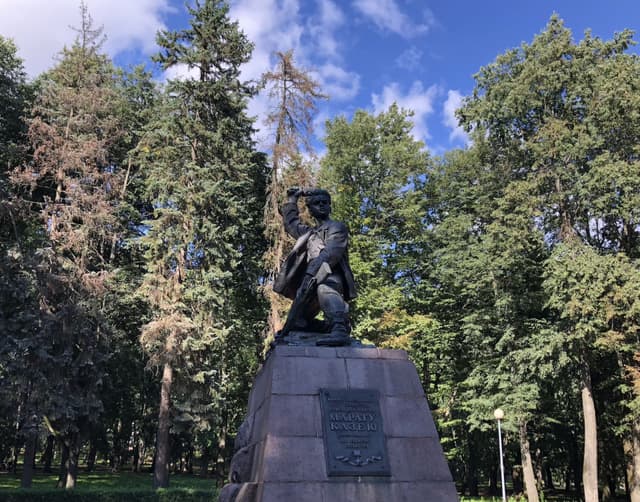
In 1959, in Minsk, in Ivan Kupala Park, pioneers collected money and erected a monument to Marat Kazey. It is a fine work by sculptor S. Selikhanov and architect V. Volchek, depicting the final moments of the young hero’s life. The monument shows a wounded boy with a grenade in his hand, ready for his last feat. Obelisks and monuments to Marat Kazey have also been erected in the Gomel, Chernihiv, and Samara regions, in Moscow, Simferopol, Udmurtia. In Minsk, there is a square and a street named after Marat Kazey. In the village of Gorval in the Rechitsa District of the Gomel Region, the pioneer camp “Marat Kazey” operated, where Soviet schoolchildren were brought up in the spirit of patriotism.The hero’s name in culture
Streets, schools, and pioneer detachments throughout the Soviet Union were named after Marat Kazey. In 1968, a cargo ship of the Far Eastern Shipping Company was named in his honor. In 1973, writer Boris Kostyukovsky published the book “Life As It Is,” dedicated to the biography and feats of Marat and Ariadna Kazey. Belarusian poet Nikolai Chernyavsky dedicated the poem “Marat’s Oath” to the hero. Writer Vyacheslav Morozov wrote several children’s books about the feat of the young partisan. Marat Kazey became the prototype of a character in the animated film “First Squad.”The significance of the feat for the present day
The fantastically heroic life of Marat Kazey is the story of a child who was a true patriot of his Motherland. He could have been evacuated or left the detachment many times. What drove the son of a hanged mother, the brother of a mutilated sister? Not only a sense of revenge for his loved ones. The children of that era were raised differently — in love for the Motherland, in selflessness and honesty with themselves and their comrades. They could not live peacefully knowing that their land was under occupation and that the enemy was destroying their people. The fourteen-year-old boy made a conscious choice — to fight to the end, sparing no life, including his own. Preserving the memory of such people — ordinary boys and girls who rose to defend their Motherland despite hardships, possible grievances, and despite their very young age — is the task of today’s generations. Marat Kazey proved that courage, heroism, and valor know no age. His example teaches us fidelity to our convictions, bravery, and readiness to sacrifice ourselves for others. In 2020, when the 75th anniversary of Victory in the Great Patriotic War was commemorated, tribute was once again paid to the heroes who laid down their lives for their native land. Among them forever remains the name of the young partisan scout Marat Kazey — a boy who became a symbol of courage, resilience, and selfless love for the Motherland.Latest Articles
.jpg&w=750&q=75)
Chinese New Year 2026: The Year of the Red Fire Horse and Its Traditions
Chinese New Year 2026 begins on February 17 and ushers in the Year of the Red Fire Horse, symbolizing energy, change, traditions, and renewal.
Read more

Who Is an “Ank” and What Does This Slang Term Mean
A detailed explanation of the slang term “ank,” its origin, traits, cultural meaning, ironic use by zoomers, and its role in modern youth language.
Read more

What Is Tilt: Causes, Signs, and How to Regain Emotional Control
Tilt is a state of emotional overload where rational thinking breaks down and impulsive actions take over, common in games, work, trading, and everyday life.
Read more

Phishing in 2026: Types, Risks, and How to Protect Your Data
Phishing uses AI and fake sites to steal data. Learn types, signs, protection methods, and actions if targeted to stay safe online.
Read more
%20(1).jpg&w=750&q=75)
Cyberbullying: Types, Consequences, and How to Protect Yourself
Cyberbullying is online psychological abuse with serious mental, social, and physical consequences; anyone can be a victim, and prevention requires awareness and action.
Read more