
January 1,19 min. to read
The Origins of the Cuman Ethnos
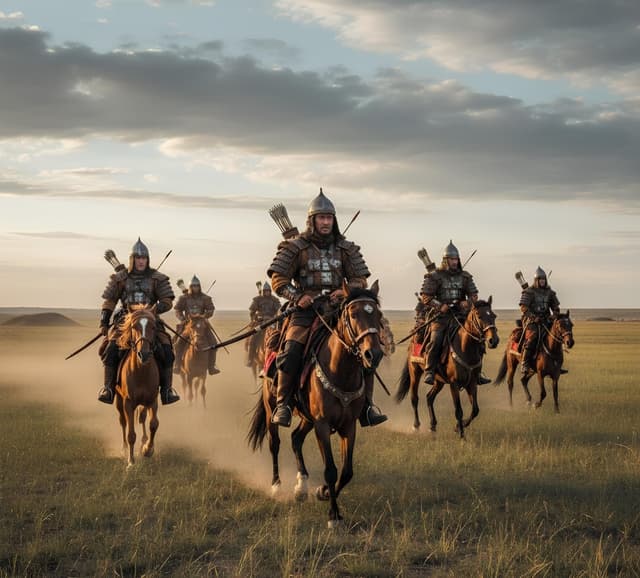
The formation of the Cuman ethnos followed patterns typical of all peoples of the Middle Ages and antiquity. One such pattern is that the people who gave their name to an entire conglomerate were not always the most numerous within it. Due to objective or subjective factors, they rose to a leading position in the emerging ethnic mass and became its core. The Cumans did not arrive in an empty land. The first component to merge into this new ethnic community was the population that had previously been part of the Khazar Khaganate — Bulgars and Alans. An even greater role was played by the remnants of the Pecheneg and Oghuz hordes. This is confirmed, first, by anthropology: outwardly, the nomads of the tenth–thirteenth centuries hardly differed from the inhabitants of the steppes of the eighth to early tenth centuries; and second, by the extraordinary diversity of burial rites recorded in this territory. A custom that arrived exclusively with the Cumans was the construction of sanctuaries dedicated to the cult of male or female ancestors. Thus, from the late tenth century, a blending of three related peoples took place in this region, forming a single Turkic-speaking community, but the process was interrupted by the Mongol invasion.Different Names for One People
The Cumans called themselves Kipchaks — from the Turkic “kïpčaq,” meaning “fortunate” or “inclined to happiness.” Hungarians and Byzantines referred to the newcomers as Cumans or Kun — most likely after the name of one of the westernmost clans. The etymology of the Russian chronicle name for the Kipchaks, “Polovtsy,” is rather obscure. It may derive from the Slavic “pole” (field) or from “polovyy” (yellow), as the dominant Cuman horde supposedly called itself “Sary-Turgesh” — “yellow Turgesh” in Turkic. The vast expanses of Eurasia inhabited by the Cuman-Kipchaks were known as Desht-i-Kipchak — “the Kipchak steppe” in Persian. The western Kipchaks, the Cumans, categorically refused to convert to Islam, remaining faithful to Tengriism — the ancient Turkic faith of their ancestors.The Way of Life of the Cuman Nomads
Nomadic Pastoralism as the Basis of the Economy
The Cumans were a classic nomadic pastoral people. Their herds included cattle, sheep, and even camels, but the main wealth of a nomad was the horse. Initially, they practiced year-round so-called camp nomadism: finding a place rich in pasture, they set up their dwellings there, and when the forage was exhausted, they moved on in search of new territory. At first, the steppe could painlessly sustain everyone. However, as a result of demographic growth, an urgent task became the transition to a more rational form of economy — seasonal nomadism. This implied a clear division of pastures into winter and summer ones, and the formation of territories and routes закрепed to each group.The Ancestral Homeland of the Cumans
The ancestral homeland of the Cumans is considered to be the vast lands of the Mongolian Altai and southeastern Tien Shan, from where their ancestors were driven by the Chinese in the sixth century into the steppes of the southern Cis-Urals. From there, these tribes, under the leadership of Khan Sharukan, moved westward toward the borders of Rus’, categorically refusing to accept Islam, which the Turkic Muslim Karakhanids attacking the region from the south were actively trying to impose. The Cuman language is relatively easy to distinguish from other Turkic languages, for example, by the well-known rounding of final sounds. Thus, the common Turkic “dag” (mountain) among the Kipchaks became “tau,” and “bek” became “bey.”The Cumans and Rus’: Complex Relations Between Neighbors
The First Clashes with the Russian Principalities
The Cumans were not the first dangerous neighbor of Rus’ — the threat from the steppe had always accompanied the country’s life. But unlike the Pechenegs, these nomads encountered not a single state, but a group of principalities hostile to one another. At first, the Cuman hordes did not seek to conquer Rus’, contenting themselves with small raids. Only when, in 1068, the combined forces of three princes were defeated on the Alta River did the power of the new nomadic neighbor become evident. Yet the danger was not recognized by the rulers — the Cumans, always ready for war and plunder, began to be used in internecine struggles. The first to do this was Oleg Sviatoslavich in 1078, when he brought the “pagans” to fight against Vsevolod Yaroslavich. In 1061, the first Cuman raid on Rus’ territory took place. Although some historians dispute the possibility of winter raids by steppe nomads, the warriors of Khan Iskal arrived on February 2. The retinue of Vsevolod Yaroslavich was defeated, the Cumans plundered the Pereyaslavl Principality and withdrew.Vladimir Monomakh and the Struggle Against the Cumans
Vladimir Monomakh fought particularly actively against the established practice of using Cumans in internecine conflicts. In 1103, the Dolobsk Council took place, at which Vladimir managed to organize the first expedition into enemy territory. The result was the rout of the Cuman army, which lost not only rank-and-file warriors but also twenty representatives of the highest nobility. The continuation of this policy forced the Cumans to migrate farther from the borders of Rus’. The boyars of the Kiev prince Sviatopolk suggested postponing the campaign, arguing that in spring the smerds needed to plow, and mobilization would exhaust their horses and disrupt sowing. Vladimir Monomakh, the leader of the campaign, objected that one should spare the smerds, not the horses: the Cumans would raid, strike the smerd with an arrow, take his horse and family. The prince was not overruled, and the campaign began. On April 4, on the Suten River, the Cuman army suffered a complete defeat. The victors obtained rich trophies, primarily livestock and captives. In 1111, a general campaign took place, bearing features of a crusade: priests with banners marched before the princes’ army. This time, the Cumans faced total destruction. In the battle on the Salnitsa River, more than ten thousand steppe warriors fell, and many were taken prisoner.The Cumans as a Tool of Internecine Strife
After the death of Vladimir Monomakh, the princes again began to bring in the Cumans to fight one another, weakening the military and economic potential of the country. In the second half of the twelfth century, another surge of active confrontation occurred, led in the steppe by Prince Konchak. It was to him that Igor Sviatoslavich was captured in 1185, as recounted in “The Tale of Igor’s Campaign.” In the 1190s, raids became fewer and fewer, and by the early thirteenth century, the military activity of the steppe neighbors had also subsided. Further development of relations was interrupted by the arrival of the Mongols. The southern regions of Rus’ were endlessly subjected not only to raids but also to the “bringing in” of Cumans, which devastated these lands. It is symbolic that the plot of the most famous monument of Old Russian literature, “The Tale of Igor’s Campaign”, is precisely this unsuccessful expedition, followed by a successful escape and a profitable marriage. The pendulum of Russian-Cuman confrontation continued to swing for some time, but it became clear to both sides that a military solution was impossible.Dynastic Marriages and Cultural Ties
Marriage Alliances Between Cumans and Russian Princes
Dynastic marriages have always been an instrument of diplomacy, and the Cumans were no exception. However, relations were not based on parity — Russian princes willingly married the daughters of Cuman princes, but did not give their own relatives in marriage. An unwritten medieval law was at work: representatives of a ruling dynasty could only be given in marriage to equals. It is characteristic that Sviatopolk himself married the daughter of Tugorkan after suffering a crushing defeat by him, that is, while being in a clearly weaker position. Yet he did not give his daughter or sister, but himself took a girl from the steppe. Thus, the Cumans were recognized as an influential, but not equal, force. While the baptism of a future wife could even be seen as a godly deed, the “betrayal” of one’s own faith was considered impossible, which is why the Cuman rulers could not secure marriages to the daughters of Russian princes. Only one case is known in which a Russian princess married a Cuman prince — but to do so she had to flee her home. Be that as it may, by the time of the Mongol invasion, the Russian and Cuman aristocracies were closely intertwined by kinship ties, and the cultures of both peoples mutually enriched each other. Many Russian princes were descendants of Cumans — their fathers often married noble Cuman women.The Cumans Beyond Rus’
Cuman Settlers in Georgia
The Cumans were friendly not only with the Russians but also with the Georgians. Through their active participation, the Cumans left their mark not only on the history of Rus’. Expelled by Vladimir Monomakh from the Seversky Donets, some of them, under the leadership of Prince Atrak, migrated to the Ciscaucasia. There, Georgia, constantly subjected to raids from the mountainous regions of the Caucasus, turned to them for help. Atrak willingly entered the service of King David and even became related to him by marrying off his daughter. He did not bring the entire horde with him, but only part of it, which later remained in Georgia. From the beginning of the twelfth century, the Cumans actively penetrated the territory of Bulgaria, which was then under Byzantine rule.The Cumans in Hungary and Bulgaria
In Hungary, as in some other European countries, the Cumans were called “Kun.” The lands on which they settled were named Kunság — Cumania. Up to forty thousand people arrived at their new place of residence. In 1237, the powerful Prince Kötöny appealed to the Hungarian king Béla IV. The Hungarian leadership agreed to grant the eastern borderlands of the state, knowing the strength of Batu Khan’s approaching army. The Cumans roamed the territories allotted to them, causing dissatisfaction among neighboring principalities that suffered periodic plundering. Béla’s heir, Stephen, married one of Kötöny’s daughters, but later, under the pretext of treason, executed his father-in-law. Only in the fourteenth century did they fully settle, become Catholics, and begin to assimilate. In Bulgaria, the Cumans were Christianized rather quickly and then dissolved among the local population. For Bulgaria, this was not the first experience of “digesting” a Turkic people. The Mongol invasion “pushed” the Cumans westward, and gradually they moved to other regions.Culture and Social Structure of the Cumans
Cuman Stone Statues
A distinctive feature of Cuman culture were the stone statues of ancestors, known as stone or Cuman “babas.” This name arose because of the emphasized breast, always hanging down onto the abdomen, which clearly carried symbolic meaning — the nourishment of the clan. Notably, a significant percentage of male statues have mustaches or even beards, while at the same time possessing a breast identical to that of female figures. The twelfth century was a period of flourishing of Cuman culture and mass production of stone statues; faces appeared in which a striving for portrait likeness is noticeable. Making stone idols was expensive, and less affluent members of society could afford only wooden figures, which unfortunately have not survived. The statues were placed on the tops of burial mounds or hills in square or rectangular sanctuaries built of stone slabs. Most often, a male and a female statue — the progenitors of the kosh — were set facing east. At their feet, archaeologists found ram bones, and once even the remains of a child. Obviously, the cult of ancestors played a significant role in Cuman life.The Status of Women in Cuman Society
In Cuman society, women enjoyed considerable freedom, although a significant share of household duties rested on them. A clear gender division of labor is noted both in crafts and in pastoralism: women were responsible for goats, sheep, and cattle, while men tended horses and camels. During military campaigns, all concerns of defense and economic activity of the nomadic camps fell on the shoulders of women. Possibly, at times they even had to become the head of a kosh. At least two female burials with staffs made of precious metals have been found — symbols of leadership of larger or smaller unions. At the same time, women did not remain aside from military affairs. In the era of military democracy, girls took part in general campaigns, and the defense of the nomadic camp during the absence of a husband also required martial skills. A stone statue of a warrior maiden has survived. This type of female warrior is reflected in Russian epic tales under the name “polyanitsy.”Cuman Writing
Nothing is known about whether the Cumans had their own writing system. Our knowledge of the Cumans is rather limited because this people never created their own written sources. We can see a great many stone statues, but we find no inscriptions on them. Information about this people comes from their neighbors. Standing apart is a 164-page notebook of a missionary-translator from the late thirteenth to early fourteenth century, better known as the “Codex Cumanicus”. The time of its creation is dated between 1303 and 1362, and the place of writing is considered to be the Crimean city of Caffa (Feodosiya). By origin, content, graphic and linguistic features, the dictionary is divided into two parts: Italian and German. The first is written in three columns: Latin words, their translation into Persian, and into Cuman. The German part contains dictionaries, grammatical notes, Cuman riddles, and Christian texts. The Italian component is more significant for historians, as it reflects the economic needs of communication with the Cumans. In it, we find such words as “bazaar,” “merchant,” “money changer,” “price,” “coin,” lists of goods and crafts. In addition, it contains words describing a person, a city, and nature. Of great importance is the list of Cuman titles.The Fate of the Cumans After the Mongol Invasion
Where the Cumans Went
No people disappears without a trace. History knows no cases of the complete physical extermination of a population by foreign conquerors. The Cumans did not disappear either. Some went to the Danube and even ended up in Egypt, but the main mass remained in their native steppes. A devastating blow was dealt to the Cumans in the 1230s by the Mongols of Batu Khan. The Cuman people then migrated — part of them, led by Khan Kötöny, with the permission of King Béla IV, went to Hungary, merging into the Hungarian people. Another part took refuge in the mountains of the North Caucasus, where, assimilating the earlier Alans, they became the Karachays and Balkars. For at least a hundred years, the Cumans preserved their customs, albeit in modified form. Apparently, the Mongols prohibited the creation of new sanctuaries dedicated to Cuman warriors, which led to the emergence of “pit” places of worship. Depressions were dug in hills or burial mounds, invisible from afar, inside which the arrangement of statues traditional for the previous period was repeated.Cuman Blood in Modern Peoples
But even with the cessation of this custom, the Cumans did not disappear. The Mongols came to the Russian steppes with families, not as an entire migrating tribe. And the same process occurred with them as had with the Cumans centuries earlier: giving their name to a new people, they themselves dissolved into it, adopting its language and culture. Thus, the Mongols became a bridge from the modern peoples of Russia to the chronicle Cumans. Many Cumans, beginning in the twelfth century, also settled in Bulgaria. However, a considerable number of Cumans remained in the Golden Horde, quickly turning it into a purely Turkic state. The Cuman language became the lingua franca of the Golden Horde. And Cuman blood flows in the veins of the direct heirs of the Golden Horde — Kazakhs, Tatars, Bashkirs, Kyrgyz, Karakalpaks, Crimean Tatars, and Nogais. It is believed that the Karachay-Balkar language has preserved the Cuman language in its original purity. It is no coincidence that in the Russian historical film “The Horde,” the speech of the Tatar-Mongols is conveyed precisely in the Karachay-Balkar language. Many Cumans gradually assimilated and dissolved among the local populations in various countries of Europe and Asia, but their cultural and genetic heritage continues to live on in modern peoples.Latest News
Kolyadki: Ancient Russian Yuletide Songs and Traditions
Ancient Russian kolyadki songs blend pagan and Christian traditions, sung during Yuletide to wish prosperity, joy, and community connection.
Read more
.jpg&w=750&q=75)
Red Square Closed on New Year’s Eve: Schedule and Celebration Alternatives
Red Square will be closed on New Year’s Eve from 6:00 PM Dec 31 to 10:00 AM Jan 1; GUM Ice Rink works, alternatives available nearby.
Read more
.jpg&w=750&q=75)
Who Were the Varangians: Warriors, Traders, and Founders of Old Rus’
Varangians, Scandinavian warriors and traders, shaped Old Rus’, founded the Rurikid dynasty, and influenced culture, trade, and military organization.
Read more
.jpg&w=750&q=75)
Who Wrote the Russian National Anthem: Authors and History
Who wrote the Russian national anthem: composer Alexander Alexandrov and poet Sergey Mikhalkov, the history of the melody, lyrics, and their role as state symbols.
Read more
Latest Articles

Slavic Gods: Pantheon, Myths, and Cultural Legacy
Overview of Slavic paganism and its main gods, their roles, symbols, myths, and lasting influence on culture, language, and traditions.
Read more

What Is Cosplay: History, Culture, and How to Get Started
An overview of cosplay as a form of creative self-expression: its history, key elements, costs, festivals, community terms, and future development.
Read more

Who Is a Geek: Meaning of the Term, History, and Modern Geek Culture
An overview of geek culture: the meaning of the term, its history, key traits, interests, and why being a geek is now mainstream and prestigious.
Read more
.jpg&w=750&q=75)
Who Is a Nerd: Meaning, History, Stereotypes, and Differences from a Geek
Who is a Nerd, the origin of the term, common stereotypes, differences from geeks, and why being a nerd today is respected and prestigious.
Read more
.jpg&w=750&q=75)
What Does “Chill” Mean? A Simple Explanation of Youth Slang
Chill means to relax and enjoy the moment without stress. The word reflects a modern youth culture of conscious rest.
Read more