
January 1,14 min. to read
What Are Kolyadki: History and Meaning
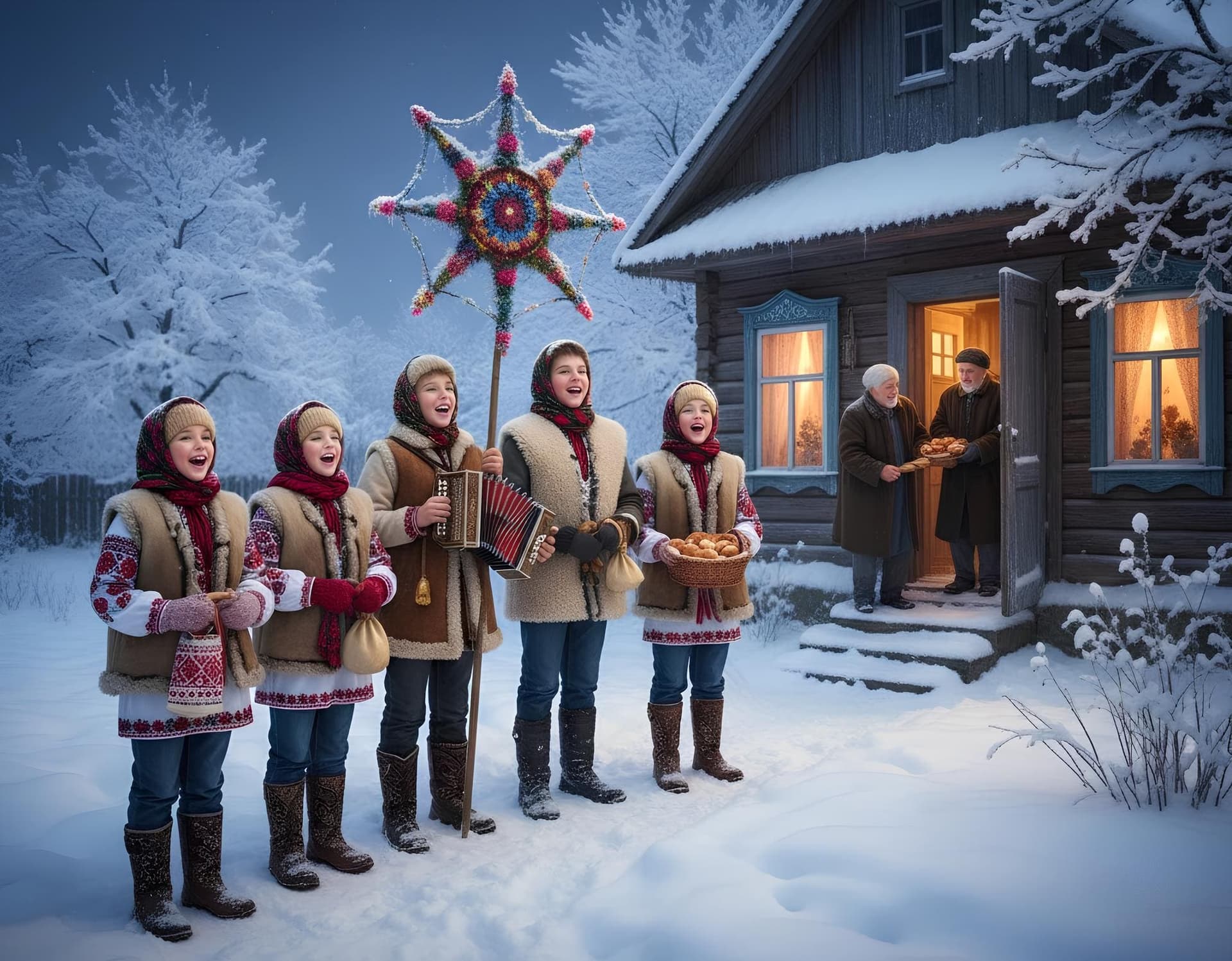
Kolyadki are traditional ritual songs performed during the winter Yuletide, starting from the night before Christmas and continuing until Epiphany. Kolyadovanie involves visiting homes by costumed singers who congratulate the hosts and wish them well in exchange for treats. The origin of the word “kolyada” is linked to the Latin term calendae, meaning the first day of the month. This tradition absorbed two powerful cultural layers, creating a unique synthesis of beliefs and customs.Pagan Roots of the Tradition
The ritual traces back to pre-Christian times, to the winter solstice celebration — Kolyada. Our ancestors believed that during this pivotal time of year, performing magical acts was especially important. The costumed singers visited homes with songs-spells, calling for good harvests, healthy livestock, and family prosperity in the coming agricultural season. Ancient Slavs attributed incantatory power to kolyadki. It was believed that a correctly sung song could “program” the future, materializing desires. The star in kolyadovanie originally symbolized the bright winter sun returning after the year's longest night.Christian Reinterpretation of the Ritual
After the Christianization of Rus’ in 988, the Church sought to imbue pagan rituals with new meaning. Kolyadki gradually transformed into khristoslavy — songs celebrating the birth of Christ. The ritual shifted from the winter solstice to Christmas, and the former sun-star became a symbol of the Bethlehem star. However, it was impossible to completely erase the ancient traditions. The result was a remarkable cultural phenomenon: in kolyadki texts, Christian images of Jesus, the Virgin Mary, and saints coexist with archaic wishes for harvests and livestock growth. Writer Nikolai Gogol described this unity in his story “The Night Before Christmas”: “The stars looked down. The moon majestically rose to shine on good people across the world, so that everyone could joyfully kolyadovat and praise Christ.”When Kolyadki Are Sung in Russia: Yuletide Calendar
Kolyadovanie spans the Yuletide period — a two-week stretch from Christmas to Epiphany. Within this period, there are especially significant dates, each with its own characteristics.January 6 — Christmas Eve
The evening of January 6 opens the Yuletide period. With the appearance of the first star in the sky, home kolyadovanie begins in a family circle. It is a time of preparation for the main holiday, when relatives gather together and sing Christmas songs.January 7–8 — Peak of Kolyadovanie
The morning of January 7 is traditionally considered the time for children’s kolyadki. After the night church service and festive feast, children and youth visit neighbors with songs praising Christmas. During these days, the ritual reaches its greatest scale: streets fill with costumed singers, songs sound, laughter and congratulations are shared.January 13 — Generous Evening
January 13 marks a special stage — the time of shchedrovki. While Christmas kolyadki focus on the newborn Jesus, shchedrovki emphasize wishes for family wealth and well-being. Songs of this evening begin with the characteristic refrain: “Generous evening, good evening!”January 14 — Old New Year
The morning of January 14 is the day of seeding. Children symbolically scatter grain in homes while singing short seeding songs like “I sow, I sprinkle, I plant, Happy New Year to all!” This ritual is considered a good omen for a rich harvest.Until January 18 — End of Yuletide
Up until the Epiphany Eve, late kolyadniki can still be found on the streets, but activity gradually declines. On January 19, Epiphany Day, Yuletide festivities officially end. Modern adaptation: today kolyadovanie is often tied to weekends, with city events and folklore festivals organized, making the ancient tradition accessible to everyone.How Kolyadki Were Sung in the Past: Open-Air Theater
In the past, kolyadovanie was a true folk performance with complex symbolism and clear structure. It was not just a visit to homes with songs but a ritual act where every element had meaning.Costumed Participants and Their Roles
Participants dressed in costumes, creating vivid characters. The main symbols of fertility were the Goat and the Bear. Costumed participants representing these animals were guided through yards by special leaders. Other popular characters included folkloric spirits, old men, and old women. People wore coats turned inside out, painted their faces with soot, and drew mustaches and eyebrows. Men dressed in women’s clothes, women in men’s. This carnival-like reversal symbolized the special Yuletide period when ordinary rules ceased to apply.Theatrical Performances
Kolyadniki did more than sing — they performed entire scenes. Accompanied by musical instruments, they depicted hunting, harvest gathering, and domestic life. The climax was often the “illness” or “death” of the Goat. If it “resurrected” from songs and generous treats, it meant nature was ready to be reborn in spring.Structure of the Ritual
Kolyadovanie followed a set scenario. First, the group asked permission to enter the yard. Then a plot-based kolyadki song was performed, with dialogue between singers and hosts. This was followed by a request for shelter and treats, sometimes with playful threats to stingy hosts. After receiving gifts, the kolyadniki thanked the hosts with a special song wishing them “livestock, little animals, children.” Refusing kolyadniki was forbidden — it was believed to bring poor harvests and misfortune. The more generously you treated the singers, the happier the year would be.What Kolyadki Sing About: Texts and Meanings
Kolyadki carry a special incantatory power. These songs are meant to materialize well-being, attract harvest and happiness to the family. Texts ranged from long narratives to short recitatives, but all followed a certain logic.Classical Structure of a Kolyadka
Typical opening: “Kolyada, kolyada, open the gates!” or “Kolyada has come on the eve of Christmas…” Then come specific wishes for all family members. The song ends with a subtle but insistent hint at a reward. Kolyada, kolyada!Give a pie,
A pancake or flatbread
Through the back window.
As many branches on the Christmas tree,
As many cows in your barn!
Open your chests,
Take out the coins!
Folkloric Nature of the Texts
Since kolyadki belong to oral folk art, there were no canonical texts. The same songs accumulated various versions over centuries. With the involvement of children’s choirs, texts simplified into short wishes with a single goal — to receive treats.Types of Kolyadki: From Khristoslavy to Seeding Songs
Despite the common name “kolyadki,” Yuletide songs were divided into several types, each with its own features and performance times.Khristoslavy
These songs praise the birth of Christ and narrate the gospel story of the Virgin Mary. They often start with “Christ is born, glorify Him!” Sung mainly during Christmas, January 6–8. Kolyadniki carried a star on a stick — symbolizing the Bethlehem star that guided people to the baby Jesus.Traditional Ritual Kolyadki
Dialogic songs with wishes for wealth and harvest, preserving ancient pagan motifs. They often feature the mythological figure Kolyada. Typical plot: a goat or other animal asks to enter the house to hide, warm up, and receive treats. In gratitude, it sings praise and knocks with hooves and horns.Shchedrovki
Performed on January 13, during Generous Evening. Characteristic refrain: “Generous evening, good evening!” Focus is on wishing abundance and prosperity. These songs are shorter and more energetic than Christmas kolyadki.Ovsienki
A type of shchedrovki with the refrain “Ovsien, ovsien, throughout all towns!” Ovsien is an ancient deity associated with the new year and fertility.Vineyard Songs
Solemn songs praising the hosts through the image of the vine — symbol of prosperity and abundance. Particularly common in the Russian North, in Pskov and other central regions.Children’s Seeding Songs
Short recitatives performed on January 14. Children entered homes and scattered grain saying: “I sow, I sprinkle, I plant, Happy New Year to all!” This simple ritual symbolized wishes for a rich harvest. Writer Ivan Shmelev in his novel “The Lord’s Summer” described children’s kolyadovanie: “Mishka Drap carries the Star on a stick — a cardboard house: windows glowing red and gold paper — a candle inside. The boys sniff and smell snow… begin in chorus: Your Nativity, Christ our God…”Kolyadovanie Today: How to Join the Tradition
The ancient ritual is experiencing a revival in modern Russia. In recent decades, interest in kolyadovanie has grown significantly, and today there are several ways to become part of this living tradition.Participating in Organized Events
Many open-air museums, cultural centers, and folklore groups host public kolyadovaniya. Especially active are wooden architecture museums like “Malye Korely” in Arkhangelsk or “Vitoslavlitsy” in Novgorod. New Year fairgrounds organize workshops where one can learn traditional songs and dances. Folklore ensembles stage theatrical performances with authentic costumes and instruments. Such events are usually announced in city posters and social media.Home Kolyadovanie
You can organize kolyadovanie in your own yard or building entrance. Coordinate with neighbors or friends and learn one or two simple kolyadki. With children, make simple props: a cardboard star, animal masks, scarves for costumes. Visit pre-notified apartments. Treats can be symbolic: candies, tangerines, homemade cookies. For children, it becomes an entertaining game with theatrical elements; for parents, a new family tradition.Safety and Modern Realities
In urban life, it is important to take reasonable precautions. Children should only visit familiar neighbors or participate in organized events with folklore groups. It is best to choose daylight — morning or early evening — for kolyadovanie.Practical Tips: How to Kolyadovat Properly
Are Special Costumes Needed?
A full masquerade costume is not required. Symbolic elements suffice: a scarf, simple paper mask, star on a stick. The main thing is to create a festive mood and feel the atmosphere. For outdoor kolyadovanie, wear warm clothing that can be decorated with bright details.What to Say During Kolyadovanie
You don’t need to memorize long texts. Learning one short kolyadka in a folk style is enough. For example: Kolyada, kolyada!Give a pie!
If you don’t give a pie —
I’ll take the cow by the horns! You can add simple greetings: “Merry Christmas!”, “Wishing happiness, health, and prosperity in the New Year!”
How to Welcome Kolyadniki
If kolyadniki come to your home, greet them with joy. According to old belief, refusing is forbidden — it may bring misfortune. Prepare small treats in advance: candies, cookies, fruits, homemade baked goods. You can give a symbolic coin. The main thing is to sincerely thank the guests for bringing the holiday into your home.The Significance of Kolyadki in Modern Culture
Kolyadki are much more than old songs. They represent a centuries-old cultural code where hope for a good harvest, Christmas joy, and human generosity are intertwined. They are a living connection to ancestors, their beliefs, and worldview. Today, the tradition is gaining new life. It adapts to urban realities and becomes part of festivals and holiday programs. The main thing remains — the spirit of community, joy, and goodwill. Kolyadovanie teaches children generosity and introduces them to history and culture. For adults, it is a way to recall roots, take a break from daily routine, and connect with the eternal. Knowing when kolyadki are sung and what meaning the ritual holds, anyone can become not just an observer but a conduit of living history. Cheerful songs, bright costumes, small performances — all require little effort but can create true magic, delight loved ones, and strengthen neighborly ties. Kolyadki in 2026: the main day is January 7. Active kolyadovanie continues until January 19. Shchedrovki are sung on the evening of January 13, and seeding songs in the morning of January 14. The revival of kolyadovanie shows that ancient traditions do not disappear without a trace. They patiently await their time and return when people feel the need for community and living contact with ancestral culture. Kolyadki are heard today in city squares and village homes, museums, and private apartments — anywhere there is a desire to experience the magic of winter holidays. May these ancient songs continue to sound, reminding us that the connection of times is unbroken, that joy can be given freely, and happiness comes to those who open the doors of their home and heart.Latest Articles
.jpg&w=1920&q=75)
Chinese New Year 2026: The Year of the Red Fire Horse and Its Traditions
Chinese New Year 2026 begins on February 17 and ushers in the Year of the Red Fire Horse, symbolizing energy, change, traditions, and renewal.
Read more

Who Is an “Ank” and What Does This Slang Term Mean
A detailed explanation of the slang term “ank,” its origin, traits, cultural meaning, ironic use by zoomers, and its role in modern youth language.
Read more

What Is Tilt: Causes, Signs, and How to Regain Emotional Control
Tilt is a state of emotional overload where rational thinking breaks down and impulsive actions take over, common in games, work, trading, and everyday life.
Read more

Phishing in 2026: Types, Risks, and How to Protect Your Data
Phishing uses AI and fake sites to steal data. Learn types, signs, protection methods, and actions if targeted to stay safe online.
Read more
%20(1).jpg&w=1920&q=75)
Cyberbullying: Types, Consequences, and How to Protect Yourself
Cyberbullying is online psychological abuse with serious mental, social, and physical consequences; anyone can be a victim, and prevention requires awareness and action.
Read more