January 2,16 min. to read
On what date is the Baptism of the Lord celebrated in 2026
The Baptism of the Lord belongs to the Twelve Great Feasts — the twelve most important church dates after Easter. This feast is connected with key events in the earthly life of Jesus Christ and the Mother of God. January 19 is the date of the Baptism of the Lord in 2026. The feast has a fixed date and is celebrated every year on the same day according to the New Style (January 6 according to the Old Style). The Baptism of the Lord is a non-movable feast, which means that its date does not depend on the Paschal calendar and remains unchanged from year to year. The feast has four days of forefeast and eight days of afterfeast — periods before and after the celebration when services dedicated to the event are already held in churches.Two names of one feast: Baptism and Theophany
This great church celebration has two widely known names, each carrying deep spiritual meaning.Why the feast is called the Baptism of the Lord
The name is directly connected with the Gospel event — the baptism of the thirty-year-old Jesus Christ in the Jordan River. The rite was performed by the prophet John the Baptist, who called people to repentance and purification from sins through sacred washing. It is in honor of this moment in the earthly life of the Savior that the feast received its first name.The meaning of the name Theophany
Until the middle of the fifth century, the Nativity of Christ and the Baptism were not celebrated separately. There was a single feast of Theophany, celebrated on January 6 according to the Old Style. It united the entire range of events from the birth of Christ to His baptism. In 451, the Council of Chalcedon decided to separate these two important events. However, the name Theophany remained attached to the Baptism, since it reflects the great miracle — the manifestation of the Holy Trinity to the world during the baptism of Jesus. Other names of the feast: the Day of Enlightenment, the Feast of Lights, the Holy Lights. All these names indicate that the Sacrament of Baptism enlightens a person with Divine Light and cleanses from sinful impurity.History of the feast: the baptism of the Savior in the Jordan
The Gospel story of the Baptism of the Lord is described in detail by the apostles Luke, Mark, and Matthew. After long wanderings in the desert, the prophet John the Baptist came to the Jordan River in the vicinity of Bethlehem. The waters of this river had been considered sacred since ancient times — it was there that the Jews performed religious rites of washing.The preaching of John the Baptist
On the banks of the Jordan, the Forerunner began to preach to people about repentance before the imminent coming of the Messiah. He called everyone to prepare for the great event by cleansing themselves of sins through the rite of baptism with water. It was John who first introduced this tradition in Judea.The meeting of Jesus and John
When the prophet saw the Messiah on the banks of the river, he bowed before Him. After Jesus Christ asked to be baptized, John the Baptist objected, declaring that he could not do this, for the true God stood before him. He said: “I need to be baptized by You, and do You come to me?” However, Jesus, who did not need baptism since He was sinless, insisted on fulfilling the ritual. He explained that He had come not to break the law, but to fulfill it, for it was necessary to accomplish all righteousness.The manifestation of the Holy Trinity
After immersion in the waters of the Jordan, a great miracle occurred. The Holy Spirit descended upon Christ in the form of a dove, and a voice was heard from heaven: “This is My beloved Son, in whom I am well pleased.” From this moment began the three-year messianic ministry of Jesus Christ. It is believed that it was at this moment that the Holy Trinity first appeared to people: God the Father — the voice from heaven, God the Son — Jesus Christ in the waters of the Jordan, and the Holy Spirit — the dove descending during the baptism.Epiphany Eve: preparation for the great feast
On the eve of the Baptism, January 18, Orthodox believers observe Epiphany Eve, which is also called the eve of Theophany. On this day, a strict fast is established for those for whom it falls on a weekday. On the evening of January 18, churches hold the Liturgy of St. Basil the Great — a special, lengthy divine service. During the service, all New Testament and Old Testament passages recounting the events associated with the upcoming feast are read. After the liturgy, the first Great Blessing of Water begins.The blessing of water: the main tradition of the Baptism
The blessing of water is the central tradition of the feast and is performed twice: on the eve in the evening and on the very day of Theophany. Regardless of when the ritual is performed, the water possesses equal grace.Epiphany water — the Great Agiasma
Water blessed on the Baptism bears a special name: Epiphany water or the Great Agiasma, which means a great holy object. The first mentions of holy water appeared as early as the 370s in the writings of Saint Epiphanius of Cyprus.How the blessing of water takes place in the church
The rite of blessing water is carried out according to a special order:- First, the troparion “The voice of the Lord is upon the waters” is sung
- Then prophecies from the Old Testament, passages from the Gospel, and a fragment from the Epistle of the Apostle Paul are read
- General petitions begin with a request to sanctify the water by the power and action of the Holy Spirit
- The priest reads a prayer and censes the water with incense
- The cross is immersed in the water three times while the troparion of the feast “When Thou wast baptized in the Jordan, O Lord” is sung
- The faithful are sprinkled with holy water and allowed to venerate the cross
An ancient tradition of blessing water
According to tradition, on the night of the Baptism of the Lord all water on earth becomes holy. During periods of persecution of the Church, when it was impossible to bless water in churches, believers drew it from ordinary bodies of water or from taps. Even without priestly prayers, this water did not spoil for several years. Saint John Chrysostom wrote: “Christ was baptized and sanctified the nature of waters; therefore, on the feast of the Baptism, all who draw water at midnight bring it home and keep it for the whole year.” The custom of pronouncing a prayer over water was introduced by the Antiochian Patriarch Peter the Fuller in the last third of the fifth century. The tradition of the double blessing of water came from the Jerusalem Church, where in the fifth century believers went out to the banks of the Jordan on the very day of the feast.The use of Epiphany water
Believers consider Epiphany water a sacred object and believe in its healing properties. Having drawn the Great Agiasma, Orthodox Christians use it throughout the year:- They drink it on an empty stomach for healing from ailments and cleansing from sins
- They sprinkle homes and churches
- They give it to people who cannot be admitted to Holy Communion
Epiphany bathing in ice holes
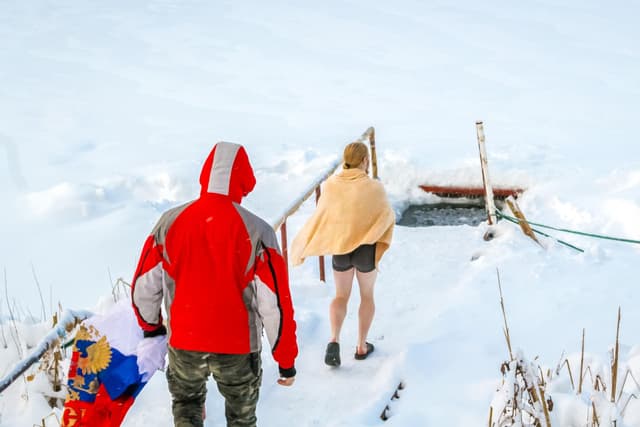
According to tradition, on the night from January 18 to January 19, Orthodox believers immerse themselves in specially prepared ice holes — Jordans. It is believed that Epiphany bathing serves as a symbol of reinforcing the cleansing from sins; however, this custom is not an obligatory church sacrament.The history of the bathing tradition
Church regulations do not prescribe believers to bathe in an icy hole. This rite arose from folk practice — Russians independently began to immerse themselves in water in memory of the baptism of Jesus Christ. The tradition gained widespread popularity relatively recently: mentions of Epiphany bathing appeared only in works of the nineteenth century. Before the Revolution, there was no mass tradition of immersion in ice holes. Epiphany bathing gained particular popularity only in the late 1990s.How to properly immerse in a Jordan
Choice of place: immersion is allowed only in an officially prepared Jordan, where medics and rescuers are on duty. Using improvised ice holes is dangerous to life due to the risk of strong currents. Clothing: people immerse themselves in a long white shirt, a swimsuit, or swimming trunks. Rubber slippers or felt boots are put on the feet and removed before immersion. Order of immersion: before immersion, it is recommended to pray to God. One enters the Jordan quickly and does not remain for long. They immerse themselves three times, accompanying this with the sign of the cross and the words: “In the name of the Father. Amen”, “And of the Son. Amen”, “And of the Holy Spirit. Amen”. After leaving the font, it is necessary to dry off, dress, and put on footwear as quickly as possible. Doctors recommend staying in icy water for no more than ten seconds.Omens and beliefs on the Baptism of the Lord
Many folk omens are associated with the feast, many of which concern the weather and the prediction of the harvest.Weather omens
- A starry night from January 18 to January 19 foretells a good berry harvest
- Heavy snowfall overnight means a rich harvest this year
- Severe Epiphany frosts exceeding Christmas frosts promise a good harvest
- A full moon in the sky predicts strong spring flooding
- Snow on Epiphany night means a rainy summer, clear skies mean a dry and hot one
- A thaw on the night from January 18 to January 19 foretells difficulties throughout the year
- A falling star in the sky means a joyful event capable of changing one’s life
Other Epiphany omens
- Snow on the day of the Baptism has healing power — rubbing the face and hands with it grants beauty and health
- Open windows and doors despite the weather help let out the bad and let in the good
- Matchmaking or a marriage proposal on this day brings heavenly blessing to the union
- Quarrels and evil thoughts on the feast can attract misfortune and come true
- Tears on the Baptism foretell sorrow for the whole year
- The barking of dogs predicts an abundance of game in the forest and money for the one who hears it
- The birth of a child on the day of the Baptism promises a happy fate
- Meeting a woman with a man carrying flowers foretells a happy year
- Broken dishes on the Baptism mean an imminent wedding
What should not be done on the Baptism of the Lord
Prohibitions related to behavior: one must not wish evil upon others, refuse help to those in need, or quarrel with people around. Even evil thoughts on this day can cause harm. Household chores: it is not recommended to clean the house — it is better to prepare the home for the feast the day before, on Epiphany Eve. On the very day of the Baptism, one should refrain from heavy physical labor. Work: although the Baptism is not a state holiday with a day off, believers are encouraged to find time to attend the festive liturgy, even if the day falls on a weekday. Laundry: washing clothes is forbidden, since all water on this day is considered holy, and using it for household needs is inappropriate.Culinary traditions of the feast
On Epiphany Eve, only Lenten dishes are served at the table. A mandatory element of the supper is sochivo — a dish made of boiled grains with the addition of honey, dried fruits, and poppy seeds. Lenten dumplings, cabbage rolls with rice, fish, vinaigrette, baked apples, and pears are also prepared. On the feast day of the Baptism itself, many meat dishes appear on the table. It is believed that the number of dishes should be seven, nine, or twelve. The meal begins with special festive cookies shaped like crosses. The Baptism of the Lord is a feast of profound spiritual significance, uniting millions of believers in prayer and reverence before the great mystery of Theophany. Regardless of whether you immerse yourself in an ice hole or simply visit a church, the main thing is to remember the spiritual meaning of this day and strive for the purification of the soul.Latest News

Heavy Snowfall in Moscow: City Services on High Alert
Heavy snowfall will continue in Moscow until January 5, with round-the-clock city cleanup, icy weather, strong winds, and safety warnings for residents.
Read more
Kolyadki: Ancient Russian Yuletide Songs and Traditions
Ancient Russian kolyadki songs blend pagan and Christian traditions, sung during Yuletide to wish prosperity, joy, and community connection.
Read more
The Cumans: Origins, Culture, and Their Role in the History of Rus’
A detailed overview of the Cumans: their origins, culture, relations with Rus’, migrations, and lasting influence on Eurasian peoples.
Read more
.jpg&w=750&q=75)
Red Square Closed on New Year’s Eve: Schedule and Celebration Alternatives
Red Square will be closed on New Year’s Eve from 6:00 PM Dec 31 to 10:00 AM Jan 1; GUM Ice Rink works, alternatives available nearby.
Read more
Latest Articles

Slavic Gods: Pantheon, Myths, and Cultural Legacy
Overview of Slavic paganism and its main gods, their roles, symbols, myths, and lasting influence on culture, language, and traditions.
Read more

What Is Cosplay: History, Culture, and How to Get Started
An overview of cosplay as a form of creative self-expression: its history, key elements, costs, festivals, community terms, and future development.
Read more

Who Is a Geek: Meaning of the Term, History, and Modern Geek Culture
An overview of geek culture: the meaning of the term, its history, key traits, interests, and why being a geek is now mainstream and prestigious.
Read more
.jpg&w=750&q=75)
Who Is a Nerd: Meaning, History, Stereotypes, and Differences from a Geek
Who is a Nerd, the origin of the term, common stereotypes, differences from geeks, and why being a nerd today is respected and prestigious.
Read more
.jpg&w=750&q=75)
What Does “Chill” Mean? A Simple Explanation of Youth Slang
Chill means to relax and enjoy the moment without stress. The word reflects a modern youth culture of conscious rest.
Read more