
10 min. to read
History of Patriarch’s Ponds: from Goat Swamp to Cultural Heritage
Early History: 17th Century
Until the end of the 17th century, the site of today’s Patriarch’s Ponds was occupied by Goat Swamp, through which the Chertory Stream and two rivers — Bubna and Kabanka — flowed. Local residents raised goats, and their wool was supplied to the royal court. The old name is still remembered by Bolshoy and Maly Kozikhinsky Lanes. In the early 17th century, the residence of Patriarch Hermogenes moved here. The swamp was drained and three ponds were created for breeding fish for the patriarch’s table. On the banks grew the Patriarchal settlement with two churches — of Hieromartyr Hermolaus and of Spyridon Trimifuntsky — and household buildings. The three ponds later gave their name to Trekhprudny Lane.Transformation after 1812
After the devastating fire of 1812, the city authorities decided to fill in two of the ponds, leaving only one — the Big Patriarch’s Pond. It was thoroughly cleaned of vegetation and silt, and a small square was arranged around it, which began to be called the Patriarch’s Pond Boulevard. In 1924, the area was renamed Pioneer Ponds, but locals continued to use the historical name. Only in 1992 was the original name officially restored.What to See at Patriarch’s Ponds
Swans and Ducks
A true living decoration of the ornamental pond. By day, waterfowl glide across the surface, swim to the banks, and readily accept treats from passersby. In the cold season, when the pond freezes, the swans are sent to winter in nurseries near Moscow.Bulgakov Square
A green corner near the intersection of Bolshoy Kozikhinsky and Spiridonyevsky Lanes has borne the writer’s name since 2015. Under the tree canopies, several pedestrian paths make for a pleasant walk at any time of year.Woland’s Bench
A wooden bench where, according to Bulgakov’s “The Master and Margarita,” Ivan Bezdomny and Mikhail Berlioz sat. During their conversation about atheism, they encountered the mysterious Woland here. The landmark is located opposite the entrance of house No. 32 on Malaya Bronnaya Street.Monument to Ivan Krylov
A tribute to the famous fabulist, erected in Ermolaevsky Lane in 1976. Sculptor Andrei Drevin depicted Krylov sitting in the park. Nearby one can see the heroes of his works:- The Monkey
- The Donkey
- The Goat
- The Bear
- The Elephant
- The Little Dog
- The Crow and The Fox
Cultural Center “House on Patriarch’s”
A modern space where people come to relax, read interesting books, meet friends, watch films, and play chess. The center combines a classic reading hall overlooking the pond, a stylish art café, and an interactive hall for screenings of Russian and foreign cinema.“The House with Lions”
A beautiful three-story mansion at 9 Ermolaevsky Lane. The representative Empire-style building resembles an old noble estate, but with exaggerated grotesque proportions. The apartment house was built at Patriarch’s Ponds in 1944–1945 for Soviet military commanders, with spacious apartments, halls, maid’s rooms, and storerooms.Interesting Facts about Patriarch’s Ponds
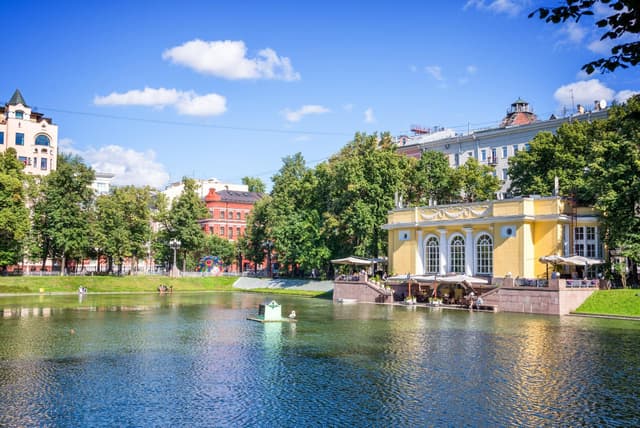
The toponym “Patriarch’s Ponds” unites the historical neighborhood, the pond, and the square. The park complex of paths and greenery covers 2.2 hectares. The reservoir itself has an area of almost 1 hectare and reaches a depth of 2.5 meters. Since 2003, the historic area in the Presnensky District has been a cultural heritage site. No tram tracks exist at Patriarch’s — and never did. The tram line was invented by Mikhail Bulgakov for his novel, creating the atmosphere of the work. In 1938, an elegant wooden pavilion was built near the pond, and in 1986 it was replaced with a stone one. The unusual building with stucco and reliefs is now occupied by a fashionable restaurant. Besides Bulgakov’s work, Patriarch’s Ponds are immortalized in literature:- poems by Yevgeny Yevtushenko
- the novel “Burnt Moscow” by Grigory Danilevsky
- Leo Tolstoy’s story “A Christmas Eve”
- the novel “Anna Karenina”
Patriarch’s Ponds in Different Seasons
In the warm season it is pleasant to stroll along the paths, feed the swans, and admire the tenement houses built on the nearby streets in the early 20th century. In spring, the Patriarch’s delights with young leaves and grass, while in autumn the Moscow park dresses in yellow and orange colors. In winter, the pond turns into a skating rink with an ice slide and a beautiful Christmas tree. This tradition is so old that in the 19th century, Leo Tolstoy used to bring his daughters here to skate. Sixteen projectors light up the rink at night, projecting snowflakes or floral images onto the ice.Where to Take Beautiful Photos
The most romantic photos are taken near the pond. Capture the swans gliding by and the tree crowns reflected in the water. Unusual shots can be made at night, under the bright evening lights. If you come in winter, photograph the snow-covered monuments and benches in the park, the lights on the Christmas tree, and the original light installations on the ice rink.Famous People at Patriarch’s
The Moscow district where Patriarch’s Ponds are located began active development in the 19th century, and by the early 20th century, representatives of the creative intelligentsia settled here. Among the famous residents of the area:- Marina Tsvetaeva was born and lived in Trekhprudny Lane
- Leo Tolstoy came here in winter to skate
- Aleksey Tolstoy enjoyed strolling along the pond
- Alexander Blok lived in one of the lanes
- Anton Chekhov rented a house here before his trip to Sakhalin
- Vladimir Mayakovsky lived in the district
- Vasily Surikov and Vasily Polenov had workshops here
Museum-Theatre “Bulgakov House”
For admirers of Mikhail Bulgakov’s works, a must-visit is the museum-theatre “Bulgakov House,” located at 10 Bolshaya Sadovaya Street. From 1921 to 1924, Mikhail Afanasyevich lived here in apartment No. 50 — the very “bad apartment” where many events of “The Master and Margarita” took place. The museum’s permanent exhibition includes:- old photographs
- documents
- Bulgakov’s medical instruments
- an electronic exhibition of his manuscripts
- films based on Bulgakov’s works
How to Get to Patriarch’s Ponds
Patriarch’s Ponds are hidden in courtyards among the many lanes of central Moscow. They are located between Malaya Bronnaya Street, Ermolaevsky Lane, and Maly and Bolshoy Patriarch’s Lanes.By Metro
The best way is to walk from the metro stations:- Mayakovskaya
- Tverskaya
- Barrikadnaya
- Pushkinskaya
Exact Address
Patriarch’s Ponds are located at: 7 Bolshoy Patriarch’s Lane, Building 1.Prices for Visiting and Entertainment
Entrance to the park around the pond: free Guided tour of Patriarch’s Ponds: from 300 rubles Quest-tour “The Master, Margarita, and Moscow”: from 600 rubles Skating rink at Patriarch’s Ponds:- Entrance — free
- Skate rental — 300 rubles/hour for adults, 200 rubles/hour for children
- Deposit — 2000 rubles
- Storage — 100 rubles
Practical Information
Address: between Malaya Bronnaya Street, Ermolaevsky Lane, and Maly and Bolshoy Patriarch’s Lanes Opening hours: 24/7 Coordinates: 55.764091, 37.591922 Patriarch’s Ponds is a unique place where history and modernity, literature and reality, mysticism and everyday life of the capital intertwine. Thanks to Mikhail Bulgakov, every cultured person in the world knows of this place, and the atmosphere of old Moscow makes it perfect for romantic walks and cultural leisure..jpg&w=750&q=75)
Sights Nearby
.jpeg&w=750&q=75)


.jpeg&w=750&q=75)

%20(1).jpg&w=750&q=75)

.jpg&w=750&q=75)
.jpg&w=750&q=75)


Latest Articles

Who Is an “Ank” and What Does This Slang Term Mean
A detailed explanation of the slang term “ank,” its origin, traits, cultural meaning, ironic use by zoomers, and its role in modern youth language.
Read more

What Is Tilt: Causes, Signs, and How to Regain Emotional Control
Tilt is a state of emotional overload where rational thinking breaks down and impulsive actions take over, common in games, work, trading, and everyday life.
Read more

Phishing in 2026: Types, Risks, and How to Protect Your Data
Phishing uses AI and fake sites to steal data. Learn types, signs, protection methods, and actions if targeted to stay safe online.
Read more
%20(1).jpg&w=750&q=75)
Cyberbullying: Types, Consequences, and How to Protect Yourself
Cyberbullying is online psychological abuse with serious mental, social, and physical consequences; anyone can be a victim, and prevention requires awareness and action.
Read more

“KFC Boss”: Meaning, Origin, and Why This Slang Term Is Considered Offensive
Explanation of the slang term “KFC Boss,” its meaning, origins, usage online, why it’s offensive, and how people respond to and protect themselves from it.
Read more