
December 26,10 min. to read
Definition of Clip Thinking
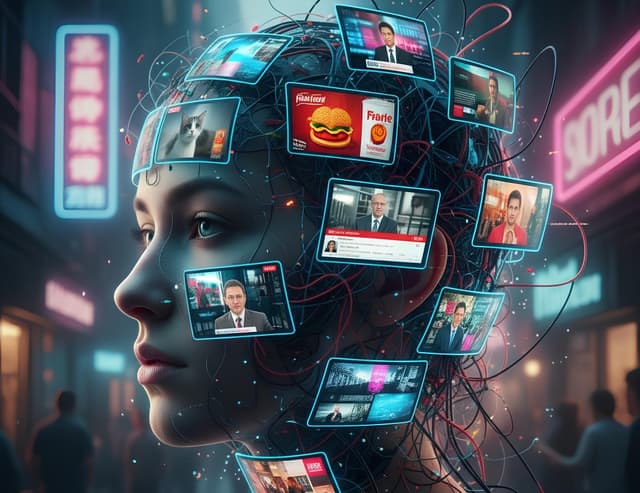
Clip thinking is a cognitive style of information processing in which a person perceives data fragmentarily, in short portions and vivid visual images. The term comes from the English word "clip," meaning a snippet or cutout. People with pronounced clip thinking have difficulty maintaining prolonged attention, constantly switching between different information streams. In contrast to clip thinking, there is systemic thinking, characterized by a sequential approach to processing information. With systemic thinking, a person perceives data as a whole, builds logical chains, deeply analyzes material, and organizes acquired knowledge. This type of thinking allows tasks to be completed step by step, finishing each stage before moving on to the next.Historical Roots of the Phenomenon
Emergence of the Concept
The concept of clip thinking emerged in the 1990s amid the rapid development of television and the rise of the internet. It was then that static images gave way to dynamic video clips and commercials with fast scene changes, focusing primarily on emotional impact. Canadian media researcher Marshall McLuhan and American sociologist Alvin Toffler independently developed the concept of clip culture. They analyzed societal transformation under the influence of electronic communications and new media formats, though they did not directly study psychological processes.The Digital Age and Social Networks
With the spread of the internet and the popularization of social platforms, the issue of clip thinking has intensified significantly. Users gained the ability to endlessly scroll through news feeds, follow hyperlinks, and consume content fragmentarily. Social media algorithms are specifically designed to maximize attention retention through short formats and emotionally engaging content. Content creators adapted to the audience’s changed perception: short videos, dynamic editing, and bright visual effects emerged. Platforms like TikTok and YouTube Shorts specialize in short videos lasting from a few seconds to several minutes, training users for instant attention switching.Factors Contributing to Clip Thinking
The development of this type of perception is driven by a combination of interconnected causes:- Early exposure to gadgets — modern children begin interacting with smartphones and tablets from infancy, forming specific information perception patterns
- Social media — constant presence on social networks with endless feeds, stories, and short videos creates a habit of fragmentary content consumption
- Video platforms — YouTube, TikTok, Instagram Reels mainly offer short clips, displacing full-length films and long formats
- Digital communication — reduced live conversations in favor of text messages and voice notes changes the nature of communication
- Repetition of information — the same ideas are duplicated in various formats, creating an illusion of knowledge with superficial understanding
- Fragmentation of messages — the habit of breaking one thought into many short, similar messages instead of presenting it coherently
Advantages of Clip Thinking
Despite common negative perceptions, clip thinking has several objective advantages, making it a valuable adaptive mechanism:Speed of Data Processing
People with clip thinking demonstrate an impressive ability to quickly grasp the essence of information and highlight key points from large data sets. This quality is indispensable in professions requiring rapid responses to multiple requests.Developed Multitasking
Clip thinking trains the ability to work simultaneously with multiple information streams. A person can study materials, listen to podcasts, respond to messages, and maintain productivity in each direction.Protection from Information Overload
In the context of daily terabytes of information, clip thinking functions as a natural filter. The brain automatically discards irrelevant data, focusing only on relevant and interesting content, preventing cognitive overload.Adaptability to Change
Individuals with clip thinking are highly receptive to new things and quickly adapt to changing circumstances. They efficiently extract necessary fragments from the overall information flow, which is useful in a dynamic modern environment.Disadvantages of Clip Thinking
Superficial Perception
The main drawback of clip thinking is its fragmentary nature and lack of deep analysis. People perceive only the surface of information without immersing themselves in context or establishing cause-and-effect relationships. This leads to incomplete and distorted understanding of complex phenomena and processes.Reduced Concentration
Constant task-switching fosters an inability to focus on a single object for extended periods. A person struggles with long texts, cannot listen to lectures or monologues for long, and quickly loses the thread in long films.Weakened Analytical Skills
Clip thinking hampers critical analysis development. Information is accepted without verification, deep reflection, or comparison with other data. The ability to build logical chains, draw reasoned conclusions, and see the full picture diminishes.Memory Decline
Fragmentary perception negatively affects memory retention. Information is absorbed superficially and quickly forgotten, failing to enter long-term memory. This is particularly critical in education.Increased Suggestibility
Lack of critical analysis makes people with clip thinking vulnerable to manipulation. They are easily influenced by emotional advertising, propaganda, and scams, often making impulsive, thoughtless decisions.Clip Thinking in Children and Adolescents
Formation Features
Children’s psyche is most susceptible to the development of clip thinking. Early interaction with gadgets, video games, and short TikTok videos creates specific information processing patterns that are difficult to change later.Educational Challenges
Students with pronounced clip thinking face serious learning difficulties:- Inability to maintain prolonged focus — homework takes hours due to constant distractions from gadgets and social media
- Poor analytical skills — difficulty building logical connections, analyzing information, and formulating conclusions
- Low academic performance — lack of understanding of the material and quick forgetting of teacher explanations leads to poor grades
- Limited vocabulary — preference for visual content over text impoverishes speech and reduces communication skills
Emotional Sphere
Constant stimulation by short emotional bursts raises the sensitivity threshold. Children become less empathetic, unable to sustain long-term empathy, and quickly forget past events, shifting focus to new stimuli.Recommendations for Parents
Experts advise limiting children’s screen time and monitoring the quality of consumed content. It is important to develop alternative leisure activities: reading, creative projects, sports clubs, and live interactions with peers.Strategies for Working with Clip Thinking
Is It Necessary to Combat This Phenomenon?
Experts differ on whether clip thinking requires correction. On one hand, it is a natural adaptation to the modern information environment. On the other hand, negative consequences may outweigh advantages, especially in education. The optimal approach is not to eradicate clip thinking but to develop a balance between fragmentary and systemic perception. It is important to learn to use the strengths of each type in appropriate situations.Practical Methods to Develop Systemic Thinking
Regular reading — classic literature, journalism, and popular science books train the ability to maintain prolonged focus. Start with short stories, gradually increasing text length and complexity. Written reflection — keeping a journal, writing detailed reviews of books and films, and essays on various topics develop analytical thinking and the ability to formulate coherent thoughts. Participation in discussions — discussing complex topics with argumentation, considering alternative viewpoints trains critical thinking and depth of analysis. Paradox method — searching for contradictions in familiar phenomena and analyzing mutually exclusive theses develops dialectical thinking and the ability to see problems from different perspectives. Digital detox — regular breaks from gadgets, social media, and digital entertainment. Replace them with walks, creativity, meditation, and face-to-face communication. Mindfulness practice — meditation techniques and concentration exercises help train the ability to focus for extended periods and control the flow of thoughts. Cognitive training — special exercises and programs for memory, attention, and logical thinking strengthen brain cognitive functions.Conclusion: Adaptation Instead of Degradation
Clip thinking should not be seen as an unequivocal evil or a sign of intellectual degradation. It is a natural brain response to a radically changed information environment. Neuroplasticity allows our brain to adapt to new conditions, developing appropriate data processing strategies. The key task for modern individuals is to develop cognitive flexibility — the ability to switch between clip and systemic thinking depending on context. Instead of memorizing vast amounts of information, it is far more important to acquire skills in quick searching, critical evaluation, and effective data use for solving specific tasks. The future belongs to people who can maximize the benefits of both thinking types, using the speed and multitasking of the clip approach where appropriate, and switching to deep systemic analysis when serious intellectual work is required.Latest Articles

Tyanka: Meaning, Origin, and Usage of the Popular Russian Youth Slang
"Tyanka" is Russian youth slang from Japanese "tyan," meaning an idealized young girl, popularized by anime culture and online communities.
Read more

Alt Subculture and Altushki: Teen Identity, Style, and Online Communities
Alt subculture ("altushki") in Russia blends bold fashion, creative self-expression, and online communities, reflecting teens’ search for identity and belonging.
Read more

What "Imba" Means in Youth Slang: Origins, Usage, and Examples
"Imba" is youth slang from gaming, meaning "cool" or "outstanding," used to praise people, skills, or things in everyday teen speech.
Read more
Generation Beta: The Next Technologically Immersed Generation Shaping 2025–2039
Generation Beta (2025–2039) will grow up fully immersed in technology, facing unique social, environmental, and digital challenges while shaping the future.
Read more

Generations by Years: Theory, Classification, and Key Differences
An overview of the theory of generations by years, explaining how historical and social conditions shape values, behavior, and differences between age groups.
Read more

Millennials (Generation Y): Traits, Values, and Influence on Modern Society
Millennials (Gen Y) grew up between analog and digital eras, valuing experiences, flexibility, self-growth, and work–life balance while shaping modern society.
Read more

Generation X: Characteristics, Values, and Role in the Modern World
An in-depth overview of Generation X: origins, values, work ethic, cultural traits, and its unique role between tradition and innovation in a changing world.
Read more

The Silent Generation: History, Values, and Lasting Impact
The Silent Generation (1925–1945) valued hard work, frugality, loyalty, and restraint, shaping postwar society, family life, and long-term economic and cultural stability.
Read more

Who Are Boomers: Traits, Values, and Their Role in Modern Society
Who boomers are: their origins, values, key traits, differences from younger generations, causes of generational conflict, and their impact on modern society.
Read more