December 26,8 min. to read
Origin of the Alt Subculture
The term "alt" comes from the English word alternative. The subculture appeared in Russia around 2020-2021, primarily on TikTok. Altushki position themselves as people who are different from the majority, seeking to stand out from the crowd and showcase their uniqueness. The movement arose as a counter to so-called straight content — ordinary, mainstream videos featuring attractive people, dancing, and popular music. Members of the alt culture wanted to create something different, outside the accepted standards and social media trends.Features of Alternative Content
Unlike standard content, alt videos do not follow popular trends and often question social norms. Creators of such content unite in fandoms — communities of fans of certain genres of literature, movies, video games, and other forms of art.Appearance of Altushki
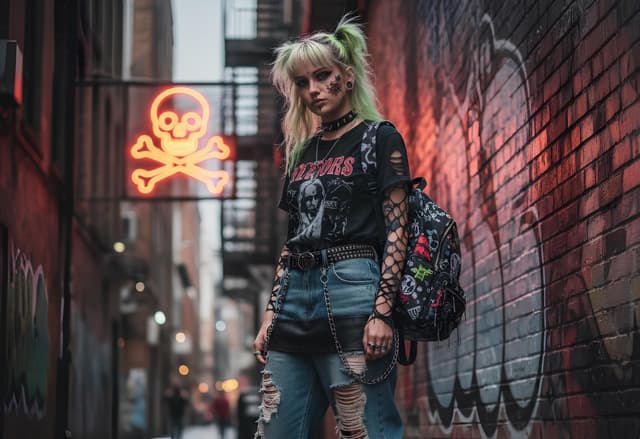
The main distinguishing feature of the subculture is a bright and provocative appearance. Altushki create looks that are hard to miss in a crowd.Clothing and Style
The wardrobe of alt culture members is a mix of elements from various subcultures. They may wear punk leather jackets, hipster decorative glasses, emo chokers, and mini skirts. Key style features include: Basic Color Palette — black dominates the wardrobe, complemented by bright accents: pink, red, green, purple, or white. Oversized and Voluminous Items — wide pants, T-shirts several sizes larger with anime prints, images of musicians, or death symbolism. Unconventional Combinations — pink Hello Kitty socks with massive black Dr. Martens boots, short skirts with oversized hoodies, ripped fishnet tights with military boots. Chunky Footwear — platform boots, canvas sneakers, old-school trainers instead of classic shoes.Accessories and Jewelry
Altushki actively use accessories to create a memorable image. Chunky chains, brightly colored belts, black mesh arm warmers, spiked chokers, numerous rings — all are typical style elements. Piercings also play an important role: earrings, pierced nose and eyebrows. An interesting feature is the combination of brutality with cute elements. An altushka may wear a headband with cat ears, pink bows, or heart-shaped earrings alongside chunky chains and spikes.Hairstyles and Hair Color
Unconventional hair coloring is one of the main signs of subculture membership. Altushki dye their hair in bright unnatural colors: neon yellow, bright pink, pale green, blue, red. Half-and-half coloring is popular — black and white, black and pink. Some create a real rainbow on their heads with multiple shades.Alt-Style Makeup
Altushki makeup is as bright and noticeable as their clothing. Characteristic features include wide eyeliner, dark eyeshadow for a smoky eyes effect, and red or pink shades. Many apply a white base for a more contrasting and dramatic look. Doll-Like Eyelashes — altushki often use extensions or glue-on lashes for a more expressive gaze. Some draw hearts or small anime-style figures on the skin, adding playfulness to the look.Psychology of the Subculture
Beneath the bright exterior lies a deep psychological need for self-expression and belonging. The alt subculture is based on the desire to oppose society and find like-minded people.Reasons for Joining the Alt Movement
Psychologists note that adolescents often join subcultures during the search for their own identity. By joining an alt community, a young person gains: - Support and understanding from like-minded peers, which may be lacking at home or school. - The opportunity to stand out and attract attention in modern society. - A means of self-expression through appearance and creativity. - Belonging to a specific social group with shared interests.Connection with Other Subcultures
Alt has absorbed traits from several previous youth movements: goth, emo, punk. Members are often linked to the "dead inside" movement — people who cultivate psychological suffering and see no meaning in life. Creative self-expression plays a crucial role in altushki life. They actively write sad poems and music, draw, and create social media content. Unlike more reserved peers, altushki openly share their creations online.Role of Parents
Psychologists emphasize the importance of parents’ proper response to a child's interest in a subculture. If a teenager fully immerses in alt culture and abandons all other interests, it may signal underlying issues. Preventing adolescent problems begins with building trusting family relationships. If contact with parents is warm and supportive, a teen will not hesitate to turn to adults with problems, even while rebelling. Demonstratively highlighting subculture affiliation can be a cry for help.Memes and Internet Culture
The alt subculture quickly became a target for online ridicule. The most famous meme is associated with the phrase "Hey, girl, you know about alt?", which appeared in a viral TikTok video. In the clip, a schoolgirl with bright makeup argues with her grandmother using this phrase.Criticism and Mockery
Social media users criticize altushki for several reasons: - Uniformity while striving to show uniqueness — all members often look similar. - Superficial engagement with hobbies — choosing "unusual" interests like heavy music or certain video games without fully understanding them. - Showiness and posing — demonstrative suffering and eccentric behavior to attract attention.Meme "Altushka from Gosuslugi"
In 2023-2024, a new meme appeared, combining altushki with another internet phenomenon — skufs. Skufs are middle-aged men with excess weight who neglect their appearance. The joke is that each Russian skuf gets their own altushka, available through the Gosuslugi portal. Humorous effect comes from the contrast between ironic youth terms and the official government service. This meme generated many videos, songs, and even computer games.Subculture as a Form of Self-Expression
Despite criticism and mockery, the alt subculture serves an important function for teenagers. It is a way to navigate the challenging period of self-definition, find a place in society, and gain support from like-minded peers. Adolescence is characterized by the search for identity and a desire to distance oneself from parents. The subculture provides a ready system of values and visual codes that help a young person answer the question "Who am I?". It is important to understand that interest in alt culture is usually temporary. As teenagers grow, most find other ways of self-expression and social integration. The key for parents is to maintain contact with the child and be ready to support them in difficult times.Latest Articles
Clip Thinking: Definition, Advantages, Disadvantages, and Impact on Children
Clip thinking is a cognitive style of fragmentary, fast information processing, shaped by digital media, with both advantages and challenges.
Read more
Tyanka: Meaning, Origin, and Usage of the Popular Russian Youth Slang
"Tyanka" is Russian youth slang from Japanese "tyan," meaning an idealized young girl, popularized by anime culture and online communities.
Read more

What "Imba" Means in Youth Slang: Origins, Usage, and Examples
"Imba" is youth slang from gaming, meaning "cool" or "outstanding," used to praise people, skills, or things in everyday teen speech.
Read more
Generation Beta: The Next Technologically Immersed Generation Shaping 2025–2039
Generation Beta (2025–2039) will grow up fully immersed in technology, facing unique social, environmental, and digital challenges while shaping the future.
Read more
Generations by Years: Theory, Classification, and Key Differences
An overview of the theory of generations by years, explaining how historical and social conditions shape values, behavior, and differences between age groups.
Read more

Millennials (Generation Y): Traits, Values, and Influence on Modern Society
Millennials (Gen Y) grew up between analog and digital eras, valuing experiences, flexibility, self-growth, and work–life balance while shaping modern society.
Read more

Generation X: Characteristics, Values, and Role in the Modern World
An in-depth overview of Generation X: origins, values, work ethic, cultural traits, and its unique role between tradition and innovation in a changing world.
Read more
The Silent Generation: History, Values, and Lasting Impact
The Silent Generation (1925–1945) valued hard work, frugality, loyalty, and restraint, shaping postwar society, family life, and long-term economic and cultural stability.
Read more

Who Are Boomers: Traits, Values, and Their Role in Modern Society
Who boomers are: their origins, values, key traits, differences from younger generations, causes of generational conflict, and their impact on modern society.
Read more